Master the Surface Solving UV-Curable System Challenges with High-Performance Leveling Agents

UV-curable technology has revolutionized the coatings and inks industry with its rapid drying times and eco-friendly profile. However, speed brings its own set of hurdles. Achieving a “mirror-like” finish in a matter of seconds requires more than just high-intensity lamps; it requires sophisticated chemistry.
For formulators seeking the perfect surface, understanding how to navigate these rapid transitions is key. Whether you are searching for a leveling agent for UV coatings or trying to prevent air release in UV ink, selecting the right additive is the first step toward a high-quality finish.
1. Why UV Systems Require Fast-Acting Leveling Agents
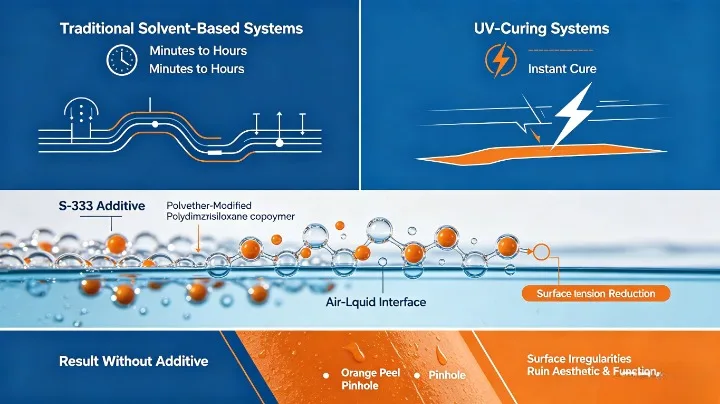
In traditional solvent-based systems, coatings have minutes or even hours to flow and level. UV systems, conversely, cure almost instantly. This leaves a very narrow window for the liquid to overcome surface tension gradients and smooth out defects like orange peel or pinholes.
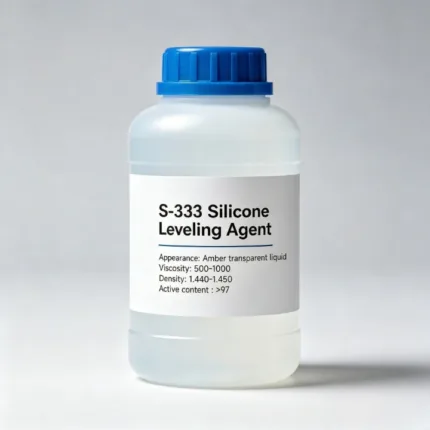
A fast-acting additive like S-333 Leveling Agent—a polyether-modified polydimethylsiloxane copolymer—is essential here. It rapidly migrates to the air-liquid interface, reducing surface tension immediately before the polymer network locks into place. Without this speed, the coating freezes with surface irregularities, ruining the aesthetic and functional value.
2. Optimizing S-333 Dosage for High-Performance UV Inkjet
Precision is everything in digital media. For high-performance inkjet inks, the balance of the formula dictates drop formation and substrate wetting.
While standard systems might only need 0.05% to 0.3% of a leveling agent, UV and water-based systems typically require a higher concentration of 0.3% to 1.0% to achieve optimal results. Using S-333 within these parameters ensures the ink spreads evenly across the substrate without clogging the delicate print heads of an inkjet system.
3. Achieving Instant Surface Slip in Fast-Curing Lines
On high-speed production lines, items are often stacked or handled immediately after the UV tunnel. If the surface isn’t slippery enough, you risk “blocking” (surfaces sticking together) or scuffing.
S-333 stands out because it significantly reduces the coefficient of friction. This provides an instant surface slip that protects the integrity of the coating during post-cure handling. If you have used industry standards like БЫК-333 (a widely recognized silicone surface additive by BYK Chemie), you will find S-333 offers very similar high-performance leveling and slip properties.
4. Compatibility with Photoinitiators and Monomers
A common challenge in UV formulation is “cratering” caused by additive incompatibility. If a leveling agent doesn’t play well with the photoinitiators or monomers, it can cause haze or surface energy issues.
S-333 is engineered for high compatibility. It integrates seamlessly into UV-curable, solvent-based, and aqueous systems without negatively impacting recoatability. This ensures that secondary layers, such as overprint varnishes, adhere perfectly to the primary coat.
5. Enhancing Scratch Resistance in UV Wood Lacquers
Wood furniture and flooring demand high durability. In these applications, a leveling agent must do more than just look good; it must protect.
By creating a smooth, low-friction surface, S-333 enhances the scratch and wear resistance of wood lacquers. It allows objects to glide over the surface rather than digging into the film. Furthermore, it works effectively in both pigmented systems and matte finishes, ensuring that even low-gloss furniture looks premium and stays protected.
Technical Tip: For best results, always add S-333 during the paint mixing stage to ensure the additive distributes evenly throughout the entire formula,Explore our full range of surface additives at sailadditive.com or contact us for a consultation.