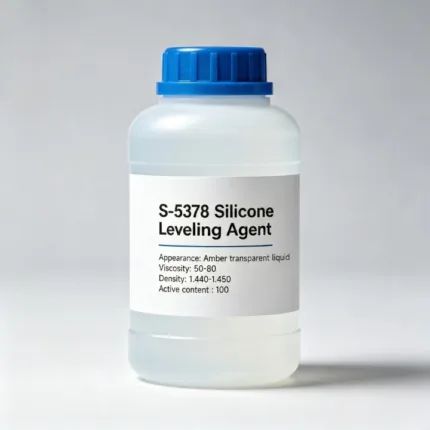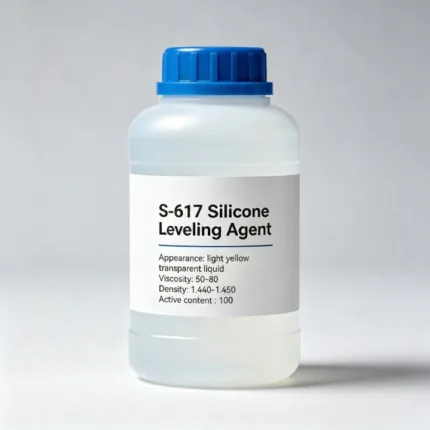
Polyether-Modified Silicone: A Deep Dive into S-378 vs. S-333

Choosing the right silicone additive is essential for creating a professional coating. Both S-378 and S-333 belong to the same chemical family, yet they offer very different results on the finished surface. Understanding these nuances helps formulators achieve the perfect balance of protection and aesthetics.
In this guide, we break down the technical characteristics of these two powerful polyether-modified siloxanes.
Technical Focus: Shared Chemical Roots
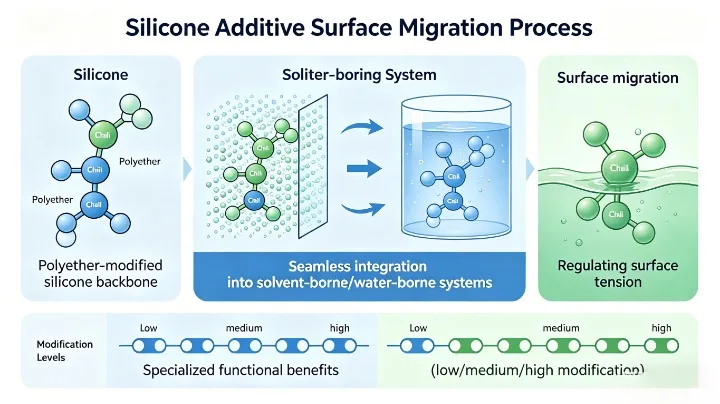
At their core, both S-378 and S-333 are polyether-modified polydimethylsiloxane copolymers. This advanced structure combines the high surface activity of silicone with the excellent compatibility of polyether.
By modifying the silicone backbone with polyether chains, these additives integrate seamlessly into aqueous, solvent-based, and even UV-curable systems. This molecular engineering allows the additives to migrate to the coating surface effectively. Once there, they regulate surface tension and provide specialized functional benefits based on their specific modification level.
Deep Comparison: S-378 vs. S-333
While they share a similar chemical foundation, their performance profiles target different formulation challenges.
S-378: The Surface Tension Specialist
S-378 is engineered for formulators who need maximum control over surface tension.
- Aggressive Tension Reduction: It excels at lowering surface tension to prevent “craters” and “fish-eyes.”
- Enhanced Atomization: In spray applications, S-378 improves the atomization of the liquid, leading to a much finer and more uniform spray pattern.
- Anti-Crater Performance: it is the go-to solution for difficult-to-coat substrates where wetting is a primary concern.
S-333: The Slip and Protection Expert
S-333 serves as a high-performance silicone surface additive known for providing excellent slip and wear resistance.
- Extreme Surface Slip: It significantly reduces the coefficient of friction to enhance surface smoothness.
- Superior Scratch Resistance: By increasing surface slipperiness, S-333 allows objects to glide over the coating, which drastically improves scratch resistance.
- Anti-Blocking: It prevents “blocking,” or the unwanted sticking together of coated surfaces when they are pressed or stacked.
For those requiring high-end international standards, products like the BYK-333 silicone surfactant offer similar high-slip and anti-blocking properties for professional industrial lines.
Application Guidance: Which One Should You Choose?
The choice depends entirely on your specific pain points:
- Choose S-378 if your paint suffers from wetting issues, orange peel, or poor spray consistency during application.
- Choose S-333 if you want to improve the final touch, protect it from scratches, or prevent stacked parts from sticking.
For many high-performance formulations, engineers actually combine different polyether-modified silicones. For example, adding a heat-stable component like S-323 ensures these properties remain intact during high-temperature baking processes up to 250°C.
Technical Data at a Glance (S-333)
- Exterior: Light yellow to amber transparent liquid.
- Density (25°C): 1.440–1.450.
- Non-volatile Matter Content: >97%.
- Viscosity (25°C): 500–1000 $mm^2/s$.
Conclusion: Precision Additives for Better Coatings
Both S-378 and S-333 provide vital functions for modern paints and inks. Whether you need the wetting power of S-378 or the protective slip of S-333, Sail Additive provides the precision chemistry needed for your success.
Ready to optimize your surface performance? Visit SailAdditive.com to explore our technical catalog or contact us to request samples today.