
Optimizing Polyurethane (PU) Inks for Flexible Packaging: Achieving Speed and Clarity

In the fast-moving flexible packaging industry, visual appeal and structural durability are essential. Brands require razor-sharp graphics, vibrant color depth, and excellent film clarity on their plastic wrap and food pouches. To meet these high expectations, ink manufacturers rely heavily on solvent-borne polyurethane (PU) resin matrices.
However, running these specialty inks on modern printing presses introduces extreme physical challenges. If your formulation cannot handle the mechanical stress of a high-speed line, you will encounter printing defects, poor ink transfer, and muddy colors.
Learning how to select a premium wetting and dispersing additive for ink systems is the key to unlocking flawless performance. This technical blog explores the rheological demands of flexible packaging, the mechanics of high-shear stabilization, and the exact guidelines needed to optimize your PU inks.
1. High-Speed Flexo and Gravure Printing: The Demand on Ink Fluidity
The plastic flexible packaging sector operates at incredible mechanical speeds. Modern flexographic and rotogravure printing presses run thin plastic films through web lines at hundreds of meters per minute. At these extreme velocities, the ink behaves under immense physical pressure.
For ink rooms, the primary pain point is achieving the perfect balance of low viscosity and high transfer efficiency. The ink must flow instantly out of the gravure cells or off the flexo anilox roller, wetting plastic films like PET, PE, or BOPP smoothly.
If the ink is too thick or sluggish, it will transfer unevenly, leaving pinholes, voids, or faint print patterns. Furthermore, poor ink transfer hurts line efficiency, forcing operators to slow down expensive machinery to avoid massive print waste.
2. Resisting High-Shear Aggregation Within the Printing Fountain
Inside the printing fountain, the ink experiences continuous mechanical churning. High-speed rollers apply massive shear forces directly to the liquid ink network. If your formulation relies on weak, low-performance surfactants, this intense mechanical stress will tear the defensive layer right off your pigment particles.
When that protective barrier breaks down, the primary pigments immediately attract one another, leading to high-shear aggregation. The newly formed pigment clumps trap liquid within their structures, causing the ink’s viscosity to spike inside the fountain.
This structural breakdown ruins flow dynamics, blocks ink cells, and leads to color flooding or doctor blade streaks across the printing film. To survive the fountain, your dispersing agent must build an unbreakable physical shield around every single pigment particle.
3. Enhancing Transparency and Gloss for Food Packaging Topcoats
In food packaging design, transparency and high-gloss aesthetics drive consumer choice. If a brand wants a clear window on a snack pouch to showcase the food inside, the topcoat or background ink must remain absolutely translucent. Any microscopic cloudiness will make the food look stale or unappealing.
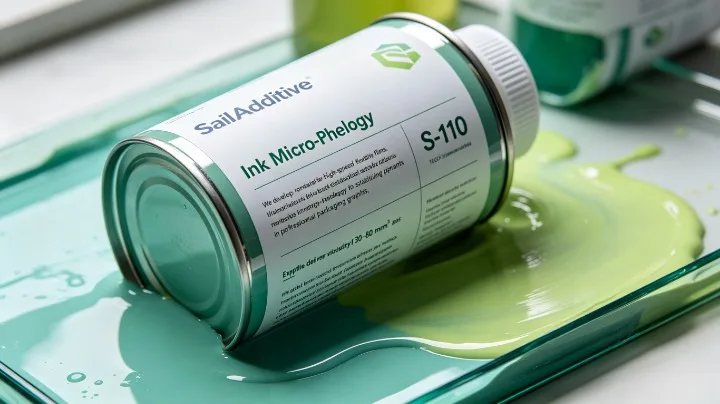
S-110 Dispersing Additive is engineered specifically to preserve this optical purity. S-110 presents as a clear, light yellow to amber transparent liquid. It dissolves perfectly within solvent-borne polyurethane and composite packaging resins, ensuring a homogenous blend.
By delivering a 100% active non-volatile matter content, S-110 introduces zero foreign carrier solvents that could weaken film properties. It isolates individual pigment particles completely, preventing the optical micro-haze that clouds plastic wrap and maximizing both color vibrancy and transparency.
4. Advanced Solutions for Packaging Ink Micro-Rheology
When developing raw materials for high-speed flexible films, formulation chemists frequently track established global standards. For example, Evonik’s TEGO® Dispers series or high-end ink dispersants from Dainichiseika enjoy strong reputations for managing micro-rheology and stabilizing pigments in professional packaging graphics.
However, operating a profitable modern printing facility requires supply chain agility and optimized raw material costs. SailAdditive’s S-110 serves as an elite peer-performing alternative, specifically designed for solvent-based PU inks.
While global brands are highly effective, they often carry steep cost premiums and face shipping delays. S-110 matches these international benchmarks by utilizing advanced steric hindrance (spatial repulsion) technology.
S-110 features an active delivery viscosity of 30–80 $mm^2/s$ at $25^{\circ}C$, allowing it to pour easily and mix directly into your varnish. It secures an outstanding balance of pigment dispersion and crisp film adhesion on difficult BOPP, PE, and PET plastic substrates.
5. Dosage Guidelines for Solvent-Based Polyurethane Varnish Systems
To achieve consistent print resolution and flawless ink transfer, you must calculate your S-110 dosage with strict precision. Because packaging inks alternate between light organic colors and heavy inorganic blockers like titanium dioxide, your addition strategy must adapt to the specific pigment type.
Always introduce S-110 into your solvent and PU resin blend during the pre-mix stage, prior to introducing any raw pigment powders. This sequence allows the active polyphosphate chains to dissolve fully and coat the particles immediately during milling.
Formulators should calculate the ideal S-110 dosage based on the total weight of the pigments:
- Inorganic Pigments ($TiO_2$, Fillers): 1.5% to 4% of the pigment weight.
- Organic Color Pigments (Cyan, Magenta, Yellow): 10% to 30% of the pigment weight.
- Carbon Blacks (For Deep Packaging Jetness): 30% to 50% of the pigment weight.
- Total Formula Approach: For clear overprint varnishes or general blended solvent inks, add 0.2% to 1.5% of S-110 based on the total formulation weight.
Conclusion: Maximize Your Printing Resolution
High-shear aggregation and sluggish ink transfer are expensive production hurdles, but you can control them through advanced surface chemistry. By incorporating S-110, you give your polyurethane packaging inks a 100% active, high-shear stabilization partner that eliminates fountain thickening, boosts gloss, and protects visual film clarity.
Stop dealing with print streaks and clogged anilox cells. Upgrade your ink rheology and ensure lasting print consistency with precision engineering.
Ready to enhance your packaging ink performance and optimize your production costs? Visit SailAdditive.com to browse our complete raw material selection, or contact our application engineers directly at 86-13713141735 to secure a sample of S-110 today.