
Understanding the Key Differences: Surfactants vs Wetting Agents vs Dispersing Agents

If you work in the coatings, ink, or agricultural industry, you’ve likely encountered the terms surfactants, wetting agents, and dispersing agents. While people often use these terms interchangeably, they serve distinct roles in chemical formulations.
Choosing the right additive can mean the difference between a high-performance finish and a failed batch. In this guide, we break down their unique functions and help you identify which one your project needs.
1. What are Surfactants?
Surfactants, short for “surface-active agents,” are the broad category of compounds that form the foundation of these additives. Their primary job is to lower the surface tension between two phases—such as a liquid and a solid, or two different liquids.
Key Characteristics:
- Dual Nature: Every surfactant molecule has a hydrophilic (water-loving) head and a hydrophobic (water-fearing) tail.
- Versatility: Depending on the formulation, they can act as detergents, foaming agents, emulsifiers, or wetting agents.
- Common Examples: Sodium lauryl sulfate (detergents) or Tween (pharmaceuticals).
Product Spotlight: S-51S Surface Additive
For those looking for high-performance surface modification, our S-51S is a premium polymeric silicone. It is specifically engineered for leather and printing inks to provide a “silky feel” while significantly boosting scratch resistance.
2. What are Wetting Agents?
ਇੱਕ wetting ਏਜੰਟ is a specific type of surfactant designed to help a liquid spread across a solid surface. Without a wetting agent, a liquid might bead up (like water on a waxed car). With it, the liquid forms a continuous film.
Key Characteristics:
- Surface Tension Reduction: They drastically lower the energy at the liquid-solid interface.
- Penetration: They allow liquids to soak into porous materials like wood or fabric more effectively.
- Primary Industries: Agriculture, printing, and industrial cleaning.
Product Spotlight: S-608 Wetting Agent

Our S-608 is a polyether-modified polydimethylsiloxane copolymer—a “superspreader”. It is incredibly effective in agricultural applications, where it ensures herbicides and pesticides penetrate plant stomata for maximum bio-efficacy.
3. What are Dispersing Agents?
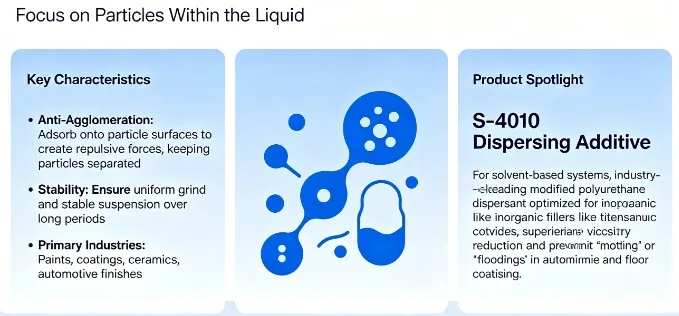
While wetting agents focus on the interface, dispersing agents focus on the particles within the liquid. They are used to prevent solid particles (like pigments or fillers) from clumping together or settling at the bottom.
Key Characteristics:
- Anti-Agglomeration: They adsorb onto particle surfaces to create repulsive forces, keeping the particles separated.
- Stability: They ensure a uniform grind and stable suspension over long periods.
- Primary Industries: Paints, coatings, ceramics, and automotive finishes.
Product Spotlight: S-4010 Dispersing Additive
For solvent-based systems, S-4010 is an industry-leading modified polyurethane dispersant. It is optimized for inorganic fillers like titanium dioxide, providing superior viscosity reduction and preventing “mottling” or “flooding” in automotive and floor coatings.
Summary: Which One Do You Need?
To achieve a professional finish, you often need a combination of these additives.
- Use a Surfactant (S-51S) to improve the overall tactile feel and surface energy.
- Use a Wetting Agent (S-608) to ensure your coating spreads evenly without beading.
- Use a Dispersing Agent (S-4010) to ensure your colors remain vibrant and your pigments don’t settle.
'ਤੇ DongGuan SailAdditive, we provide the technical expertise and high-performance chemicals to optimize your formulations.
Ready to enhance your product performance? Send a email contact our technical for a consultation or to request samples.