
From Lab to Scale-Up: 5 Critical Steps to Switch from EFKA 4010 to S-4010 Dispersing Agent

Replacing a core raw material in industrial coating formulations requires extreme caution. Formulators and procurement managers often want to replace expensive imported additives to cut costs and secure supply chains. However, they fear that changing a dispersant mid-stream might cause paint defects, viscosity drift, or batch-to-batch instability.
Transitioning from an established benchmark like BASF EFKA 4010 to a cost-effective option does not have to be risky. To solve this issue, SailAdditive developed S-4010 Dispersing Agent, a high-performance modified polyurethane polymer engineered for solvent-borne, water-based, and UV coating systems.
In this guide, we walk you through a proven 5-step lab-to-production evaluation protocol. Follow these steps to transition seamlessly from EFKA 4010 to S-4010 Dispersing Agent while reducing your additive costs by 15% to 30%.
Why Switch Dispersants? Balancing Risk and Reward
Additive packages make up a small fraction of a total coating formula. Nevertheless, polyurethane dispersants play a decisive role in pigment wetting, viscosity control, and long-term shelf stability.
When price hikes or supply chain bottlenecks hit benchmark products, formulators need reliable backup options. Furthermore, continuing to pay high brand premiums erodes manufacturing margins in competitive markets.
S-4010 Dispersing Agent offers a 100% active content polymer matrix that maximizes pigment efficiency and slashes milling time. By executing a structured lab scale-up protocol, your technical team can validate S-4010 safely without risking production downtime.
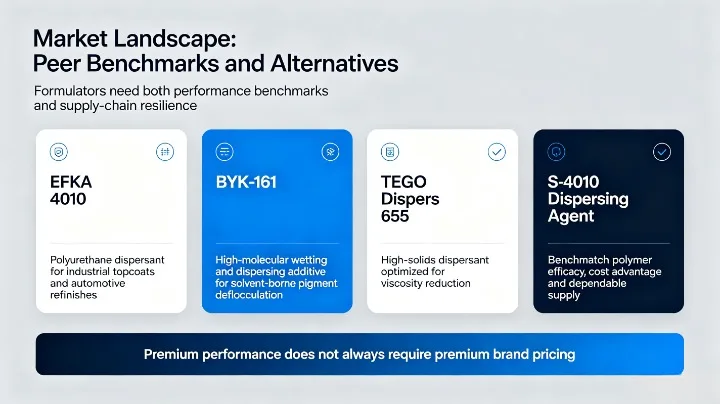
Market Landscape: Peer Benchmarks and Alternatives
Understanding market alternatives helps formulators benchmark performance during laboratory evaluations.
Several premium dispersants dominate the industrial coatings market:
- BASF produces EFKA 4010, a widely recognized polyurethane dispersant for industrial topcoats and automotive refinishes.
- BYK supplies BYK-161, a high-molecular-weight wetting and dispersing additive designed to deflocculate pigments in solvent-borne systems.
- Evonik offers TEGO Dispers 655, which excels at viscosity reduction in demanding high-solids formulations.
While these brands deliver high technical performance, S-4010 Dispersing Agent matches their polymer efficacy while delivering substantial cost advantages and dependable supply.
Technical Specifications: S-4010 vs. Benchmark
Before initiating lab testing, technical teams must compare fundamental physical properties. S-4010 offers a concentrated, versatile profile.
| Parameter / Feature | S-4010 Dispersing Agent PDF | EFKA 4010 (Benchmark) |
| Chemical Structure | Modified Polyurethane Polymer | Modified Polyurethane Polymer |
| Non-Volatile Matter Content | 100% (120°C / 2h) | ~50% (Solvent Cut) |
| Viscosity (25°C, $\text{mm}^2/\text{s}$) | 1000 – 2000 | 300 – 700 |
| Exterior | Yellow Transparent Liquid | Clear Yellow Liquid |
| Target Systems | Solvent-based, Water-based, UV, Inks | Solvent-borne Industrial |
| Primary Pigment Focus | 2_3, Organic Pigments | Inorganic & Organic Pigments |
Note: S-4010 contains 100% active content. Therefore, formulators should adjust solvent ratios when calculating 1:1 active replacement against solvent-diluted benchmarks.
The 5-Step Evaluation Protocol for S-4010 Dispersing Agent
To guarantee a smooth transition from initial bench testing to full factory production, follow these five essential steps.
[Step 1: Dosage Calculation] ➔ [Step 2: Pre-Mixing Order] ➔ [Step 3: Ladder & Viscosity Test] ➔ [Step 4: Film Defect Check] ➔ [Step 5: Factory Scale-Up]
Step 1: Calculate the Optimal Dosage on Pigment (DOP)
Proper dosage calculation prevents both under-dispersing (which causes flocculation) and over-dispersing (which causes foam and poor water resistance).
SailAdditive recommends the following starting dosage guidelines:
- Standard Formula Addition: 0.1% to 5.0% of total formulation weight.
- UV & Water-Based Systems: 0.3% to 1.0% of total formulation weight.
- Inorganic Fillers & Titanium Dioxide (2): 1.0% to 3.0% on pigment weight.
- Organic Pigments & Carbon Black: 10% to 30% on pigment weight.
Step 2: Establish the Correct Incorporation Order
Incorrect additive incorporation order often leads to incomplete polymer dissolution and pigment shock.
To maximize performance, formulators must add S-4010 Dispersing Agent during the initial paint mixing stage before introducing dry pigments. Thoroughly homogenize S-4010 into the resin and solvent mixture. This step ensures optimal polymer distribution across the liquid phase prior to grinding.
Step 3: Run Dosage Ladder Studies and Viscosity Plots
Once you incorporate S-4010, prepare three lab-scale millbases at varying additive concentrations (e.g., 80%, 100%, and 120% of your current benchmark active level).
Next, run the millbase through a laboratory bead mill. Measure fineness using a Hegman gauge and plot millbase viscosity curves over time. S-4010 significantly enhances dispersion efficiency, slashes grinding time, and provides superior viscosity-reducing power. It stabilizes difficult inorganic fillers like titanium dioxide and calcium carbonate into uniform grinds.
Step 4: Verify Film Appearance and Conduct Defect Troubleshooting
After completing the millbase, prepare full coatings and apply test panels across your targeted applications (such as floor, coil, or automotive coatings).
Check for key surface properties and potential defects:
- Anti-Settling & Anti-Flooding: Verify that mixed pigment systems show no floating, flooding, or mottling.
- Rub-Up Test: Perform a rub-up test on half-dried film to confirm complete steric stabilization.
- Gloss & Matting Control: Verify that S-4010 boosts surface gloss in high-brilliance finishes or optimizes matte powder orientation in low-gloss coatings.
- Heat Aging: Store sealed paint samples at 50°C for 14 days to confirm zero viscosity drift or hard settling.
Step 5: Execute a Controlled Factory Pilot Run (Scale-Up)
Once lab test panels pass all quality gates, transition to a pilot batch (50 kg to 200 kg) in your production plant.
Monitor real-world processing parameters during scale-up:
- Confirm that bead mill dwell time matches lab predictions.
- Verify that S-4010 flows smoothly during automated dosing.
- Test final paint samples against factory QC standards before approving full 1-ton production runs.
Target Application Scenarios for S-4010
Because S-4010 functions as a versatile, universal dispersant, technical teams can deploy it across diverse industrial coating sectors:
- Automotive & OEM Coatings: Delivers high brilliance, deep jetness, and zero haze.
- Coil Coatings: Maintains film flexibility and high gloss during high-temperature baking cycles.
- Floor Coatings: Prevents heavy filler settling (3) and eliminates color floating in thick films.
- Wood & Plastic Coatings: Improves pigment transparency, color development, and matting agent distribution.
Storage, Handling, and Packaging Specifications
To ensure long-term stability in your warehouse, observe standard chemical handling guidelines:
- Packaging: S-4010 comes standard in 25L drums or 200L plastic/steel barrels.
- Storage Conditions: Store in airtight containers in a cool, dry place. Under proper conditions, S-4010 maintains a 24-month shelf life.
- Transportation: Transport S-4010 safely as a non-hazardous chemical product.
Upgrade Your Formulations with S-4010 Today
Switching dispersants does not have to compromise paint quality or create factory downtime. By following this 5-step evaluation protocol, you can transition from EFKA 4010 to S-4010 Dispersing Agent smoothly, protect your margins, and eliminate supply chain bottlenecks.
The technical specialists at SailAdditive stand ready to support your lab evaluation with technical guidance, dosage calculations, and free evaluation samples.
Are you ready to optimize your coating formulations and lower additive costs? Contact SailAdditive today to request your free S-4010 sample package and start your lab evaluation!