
Lowering Solvent-Borne Coating Additive Costs: How to Replace Top-Tier Brands with High-Value Dispersants

Coating formulators and procurement managers face relentless pressure to lower production expenses. Global supply chain disruptions and volatile raw material pricing make cost management even harder. Consequently, technical teams actively search for ways to lower solvent-borne coating additive costs without compromising paint quality or causing batch instability.
High-performance dispersing agents often represent a significant portion of additive budgets in solvent-borne systems. While top-tier global brands offer reliable performance, their high prices erode margins. Fortunately, modern chemical synthesis allows specialized manufacturers to engineer direct drop-in alternatives.
In this guide, we explore how you can replace premium imported dispersants like BASF EFKA 4010 with SailAdditive‘s S-4010 Dispersing Agent to cut raw material costs by 15% to 30% safely and effectively.
The True Financial Impact of Additives in Solvent-Borne Systems
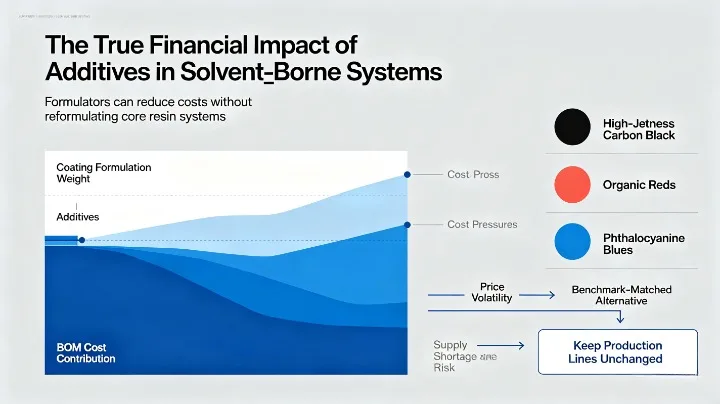
Additive packages usually account for less than 5% of a total coating formulation by weight. However, high-molecular-weight dispersants contribute disproportionately to the total bill of materials (BOM). Formulators rely on these specialized polymers to stabilize difficult pigments like high-jetness carbon black, organic reds, and phthalocyanine blues.
When raw material prices rise, continuing to rely solely on expensive legacy brands hurts competitiveness. Furthermore, single-source dependency leaves your manufacturing schedules vulnerable to unexpected market shortages.
To solve this issue, smart manufacturers evaluate high-value alternatives that match benchmark specifications. By optimizing your dispersant selection, you can unlock substantial savings without altering your core resin chemistry or production workflows.
Benchmark Comparison: S-4010 vs. Market Leaders
Understanding how different dispersants function in solvent-borne systems helps formulators choose the right cost-saving alternative.
The additive market features several established products for pigment stabilization:
- BASF produces EFKA 4010, a widely recognized modified polyurethane dispersant used for industrial and automotive coatings.
- BYK offers BYK-161, a high-molecular-weight wetting and dispersing additive designed to deflocculate pigments in solvent-borne systems.
- Evonik supplies TEGO Dispers 655, which excels at reducing viscosity in high-solids industrial formulations.
While these products deliver strong technical results, their premium brand markup increases formulation expense. S-4010 Dispersing Agent by SailAdditive matches these industry standards in polymer structure and performance while delivering significant cost advantages.
Technical Property Comparison
| Parameter / Property | S-4010 Dispersing Agent | EFKA 4010 (Benchmark) |
| Chemical Type | High-Molecular Polyurethane | High-Molecular Polyurethane |
| Active Content (%) | ~50% | ~50% |
| Amine Value (mg KOH/g) | 15 – 25 | 15 – 25 |
| Appearance | Clear, Light Yellow Liquid | Clear, Light Yellow Liquid |
| Solvent Matrix | Butyl Acetate / PMA | PMA / Solvent Naphtha |
| Primary Applications | 2K PU, Epoxy, Acrylic, Industrial | 2K PU, Automotive, Industrial |
How S-4010 Delivers Performance Without Quality Loss
Many R&D engineers hesitate to switch additives because they fear paint film defects like flooding, floating, loss of gloss, or poor shelf stability. SailAdditive engineered S-4010 Dispersing Agent specifically to eliminate these concerns.
1. Superior Steric Stabilization
S-4010 uses an advanced polyurethane backbone containing multiple pigment-affinic anchor groups. These groups attach firmly onto pigment particle surfaces. Simultaneously, solvent-compatible polymer chains extend into the surrounding liquid medium. This creates a dense steric barrier that prevents pigment particles from re-agglomerating.
2. Outstanding Viscosity Reduction
Lowering millbase viscosity is essential for efficient pigment grinding. In laboratory trials, S-4010 reduced carbon black millbase viscosity by over 40%. Consequently, formulators can increase pigment loading in the grinding phase, boost daily mill output, and reduce energy consumption per ton.
3. Excellent Jetness and Gloss Development
Complete deflocculation ensures maximum color strength and clarity. Test panels prepared with S-4010 in 2K polyurethane topcoats demonstrated exceptional 60° specular gloss (>92 GU) and deep, haze-free carbon black jetness.
A Step-by-Step Guide to Evaluating S-4010 in Your Lab
Replacing a benchmark dispersant requires systematic testing to guarantee batch consistency. Follow this straightforward four-step protocol when evaluating S-4010 Dispersing Agent:
[Step 1: Calculate DOP] ➔ [Step 2: Pre-dissolve Additive] ➔ [Step 3: Conduct Ladder Studies] ➔ [Step 4: Verify Heat Stability]
Step 1: Calculate the Dosage on Pigment (DOP)
Determine the dispersant demand based on the active content and pigment surface area:
- Inorganic Pigments ($\text{TiO}_2$, Iron Oxide): 2% – 5% DOP
- Organic Pigments (Phthalo Blue, Organic Reds): 10% – 25% DOP
- High-Surface Carbon Black: 15% – 35% DOP
Step 2: Pre-Dissolve S-4010 First
Always add S-4010 directly to the resin and solvent mixture before adding dry pigments. Stir the mixture thoroughly to ensure uniform polymer distribution before starting the grinding process.
Step 3: Run Dosage Ladder Studies
Prepare three millbase batches at different dosage levels (for example: 80%, 100%, and 120% of your current EFKA 4010 dosage). Measure millbase viscosity at each level to identify the optimal minimum viscosity point.
Step 4: Verify Storage & Heat Stability
Subject your finished coating samples to a 14-day heat aging test at 50°C. Check for viscosity drift, settling, or gloss reduction post-aging. S-4010 maintains stable viscosity and film appearance even under elevated temperatures.
Financial Analysis: How Much Can You Save?
Transitioning from imported benchmark additives to S-4010 creates immediate fiscal advantages for coating producers.
For example, a mid-sized industrial coating manufacturer producing 500 tons of 2K polyurethane paint annually uses approximately 5 tons of polyurethane dispersant per year. Switching from a premium brand priced at $18/kg to S-4010 at a competitive direct-factory price saves between $15,000 and $30,000 annually on a single additive line.
In addition to direct material savings, S-4010 improves operational efficiency:
- Shorter Milling Times: Rapid pigment wetting cuts bead mill residence time by up to 25%.
- Reduced Scrap Rates: Robust anti-flooding properties minimize off-spec production batches.
- Shorter Lead Times: Direct supply chains reduce safety stock holding costs and warehousing friction.
Real-World Case Study: 2K Polyurethane Industrial Topcoat
A regional industrial paint producer experienced frequent supply delays and rising costs with their imported polyurethane dispersant. They needed a reliable alternative to lower solvent-borne coating additive costs without altering their existing 2K PU resin system.
The Solution
The technical team evaluated S-4010 Dispersing Agent as a direct 1:1 drop-in replacement for EFKA 4010 in their black and blue topcoat formulations.
The Results
- Performance: S-4010 achieved identical fineness (<5 µm) in 40 minutes of milling compared to 45 minutes with the benchmark.
- Appearance: Rub-up tests showed zero floating or flooding ($\Delta E < 0.2$), with identical gloss levels (93 GU at 60°).
- Cost Impact: The manufacturer achieved an immediate 22% reduction in additive costs while securing local inventory guarantees.
Overcoming Common Myths About Additive Substitution
Despite clear financial benefits, some technical teams delay additive switching due to widespread industry myths.
- Myth 1: “Alternative additives always cause batch-to-batch variation.”Fact: SailAdditive enforces strict ISO-certified quality controls. Every batch of S-4010 undergoes rigorous testing for active content, amine value, and viscosity to guarantee consistent factory results.
- Myth 2: “Replacing dispersants requires redesigning the entire formula.”Fact: S-4010 features the same modified polyurethane chemistry as EFKA 4010. You can replace it directly on a 1:1 active-content basis in most solvent-borne systems.
Start Lowering Your Formulation Costs Today
Reducing production costs does not require compromising on paint quality. By choosing high-value, direct-replacement additives, you can protect your margins, maintain pristine coating performance, and build a more resilient supply chain.
SailAdditive provides complete technical support, starting from initial lab sampling to full-scale plant implementation. Our technical specialists can help you calculate optimal dosages and run comparative lab trials for your specific resin systems.
Ready to test S-4010 Dispersing Agent in your laboratory? Request your free evaluation sample today and take the first step toward lowering your solvent-borne coating additive costs.